Saturday, 25 November 2023

The Legacy and Future of Seirafian Rugs


Opinion piece:


The Legacy and Future of Seirafian Rugs

by

Hamed Sanei

Hamed Sanei is a professor of geoscience at Aarhus University, Denmark. Alongside his academic profession, he has been a connoisseur of Persian art, especially Isfahan rugs, for over three decades.

The author has not received any financial contributions, emphasizing that this is not a paid advertorial.


Summary

The article delves into the exceptional allure of Seirafian rugs. It traces the workshop's historical emergence, emphasizing its association with artistic luminaries and the cultural context that fostered its rise to prominence. It highlights the workshop's commitment to original designs and meticulous craftsmanship, which captivated collectors and connoisseurs. Despite the workshop's historical eminence, the article discusses the contemporary challenges faced by newer generations in maintaining the brand's artistic and qualitative standards. However, amidst these challenges, it praises the work of Karim Seirafian, who stands out for his adherence to the original artistic principles and execution, offering a beacon of hope for the brand's future. The article concludes by advocating for a return to the foundational principles of the past, urging other producers within the Seirafian brand to follow Karim's lead in preserving the legacy through quality, originality, and honoring the artisans.


What Makes Seirafian Rugs Exceptional

Many inquire about the allure of Seirafian rugs and their steep prices. To comprehend this, one must delve into the intricate process of rug making, distinguish between functional floor coverings and artistic masterpieces, and assess the provenance and originality of the rug.

The Seirafian workshop boasts a storied history, emerging in 1940 at the tail end of the Great Depression. This epoch coincided with an upturn in economic conditions and a resurgence of interest in Iran’s illustrious arts, fostered by luminaries like Arthur Pope. Iranian artists, inspired by the grandeur of past eras, particularly the Safavid and Seljuk dynasties, birthed a new cadre of masters. Notable figures such as Haj Mirza Agha Reza Emami and his protégés like Ahmad Archang, Haj Mosavar, Isa Bahadori, Rostam Shirazi, and others spearheaded this artistic renaissance.

Amidst Iran’s burgeoning civilization and the prosperous reign of Mohammad Reza Shah Pahlavi, Persian art flourished. The Seirafian workshop carved a niche in artisan rug making by upholding unparalleled standards of weaving, quality, and artistic finesse. Commissioning designs exclusively from two of the era’s greatest minds, Ahmad Archang and Haj Mosavar, the workshop ensured originality. These designs, not replicated from existing art but crafted expressly for weaving Persian rugs, were meticulously supervised by the Seirafians themselves and executed using only the finest materials.

The resulting Seirafian rugs soon captivated collectors, Persian rug aficionados, royalty, and the affluent for their spectacular beauty and originality. Decades later, Seirafian rugs stand as the pinnacle of weaving art, treasured by connoisseurs and museums alike.

A key reason for the exorbitant value of Seirafian rugs lies in their genesis. Each rug is meticulously woven, knot by knot, following the original hand-drawn design penned by the grand master, an original art piece boasting impeccable provenance. While a limited number of copies may exist, they still retain the hallmark of the great designers' original pen. Distinct from the myriad replicas flooding the market, these rugs stand as true works of art safeguarded by the workshop.


Contemplating New Seirafian Rug Purchases

While Seirafian rugs continue to be crafted, not all are deemed collectible for two primary reasons.

Firstly, the workshop has never been operating as a unified entity, resulting in variability in the products, with some straying from the stringent standards of the early Seirafian lineage.

Secondly, a looming threat to the artisan brand arises from unauthorized alterations to the original designs. Some producers employ modern technologies to modify and create iterations of the original works, compromising their originality and provenance. Although these rugs serve as exquisite furnishings, they lack the essence of original art.


Observing the Current Seirafian Workshop Status

As a discerning observer of the Seirafian workshop, I've witnessed a rather decline. While most of the recent works are more or less aligned with their forefathers' standards, some of the new rugs fall short in terms of both artistic merit and quality. Some productions seem to deviate from the ethos of Seirafian.


Hope for the Seirafian Brand and the Karim Seirafian Phenomenon

In this somewhat dim landscape of Persian rug art, a bright star shines: Karim Seirafian, son of the late Sadegh Seirafian. With over three decades of rug production, Karim’s creations are highly sought after, commanding premium prices. His success stems from not only his mastery in rug making but also his profound scholarly insight into Persian art, particularly Isfahan’s historical artistry. Adhering to the original Seirafian formula by engaging the best artists and utilizing superior materials, Karim's rugs stand out for their flawless execution of the original designs penned by master artists.

Mehrdad Sadri stands as an exemplary figure among the new generation of designers who have undergone formal training in the classic school of Isa Bahadori and Rostam Shirazi. His collaboration with Karim Seirafian marks the initiation of a new chapter in the grandeur of Seirafian rugs, akin to the impactful contributions of Ahmad Arhcng and Haj Mosavar.


Advice for Other Seirafian Rug Producers

To reclaim their former glory, workshops should heed the successful formula of the past by engaging eminent artists to create new designs rooted in Persian culture. Although this might increase production costs, the market will eventually reward this dedication. Prioritizing the use of superior materials and dyes, and acknowledging and rewarding the craftsmen, is vital. These artisans are the stars of this artistic endeavor and deserve recognition for their invaluable contribution.

I implore other family members producing under the Seirafian brand to emulate Karim Seirafian's approach. His dedication upholds the legendary Seirafian brand, setting a benchmark for quality and originality. Learning from his methods would be instrumental in preserving the Seirafian legacy.


Master Karim Seirafian, 

Master Mehrdad Sadri, Designer

Master Haj Mosavar, Designer

Master Ahmad Archang, Designer


Sunday, 29 January 2023

Emami circa 1920 Isfahan rug masterpiece - *****Available*****

Spectacular antique 1920 Isfahan by the late grandmaster Mirza Agha Reza Emami  AVAILABLE , contact for details 


Tuesday, 19 April 2022

Midnight Blue - mint condition- *****Available*****

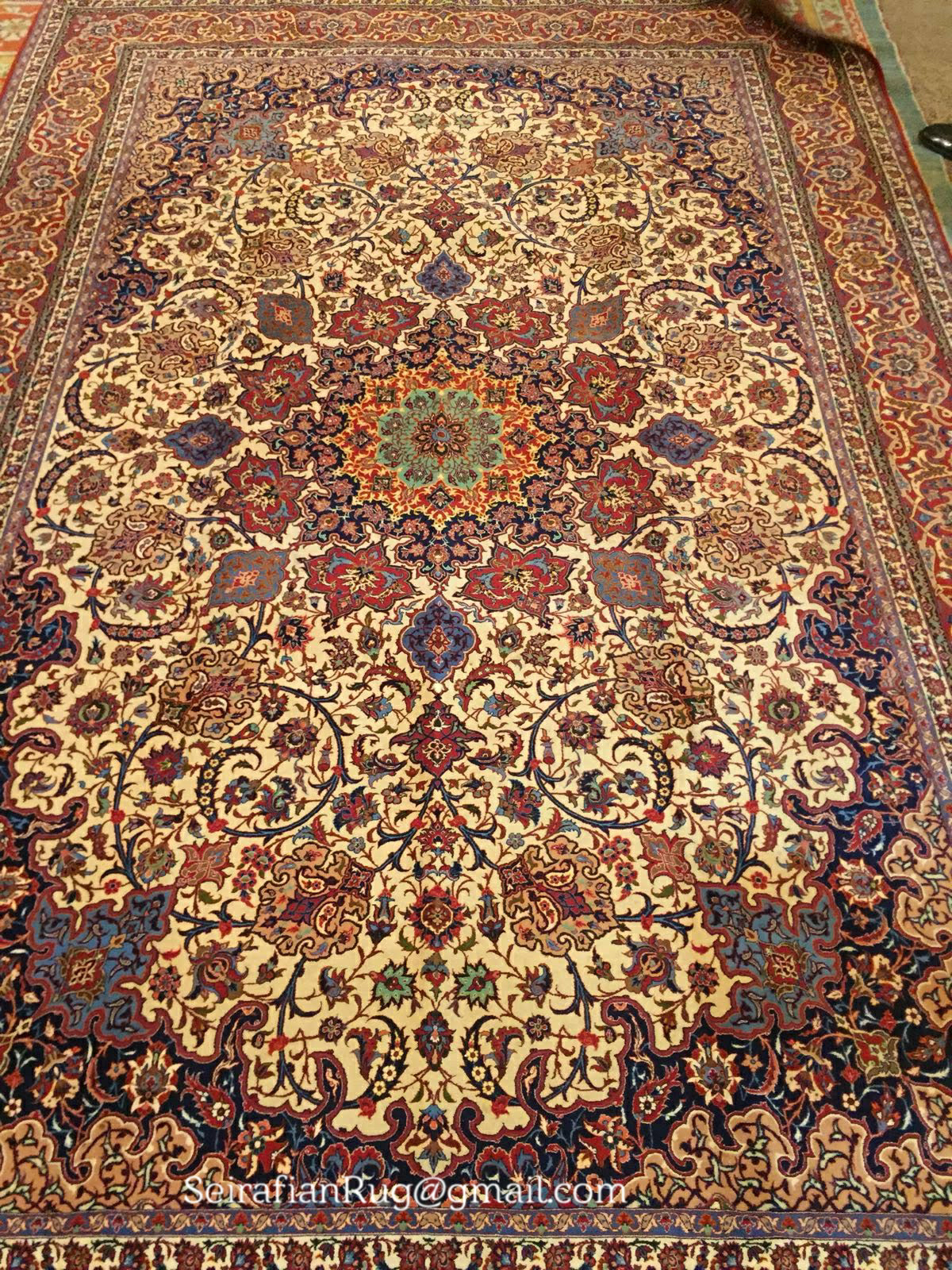
A great masterpiece of Isfahan, spectacular beauty of a Persian rug from the legendary Seirafian workshop. Breathtaking double superimposed floral swirls (arabesque) and glaring 16 points medallion on a dark indigo background designed by no one but the legendary grandmaster Ahmad Archang.

Wednesday, 18 March 2020

Examples of counterfeit, fake Seirafians being sold in the famous and reputable auction houses.

Seirafian (Seyrafian , Seirafian , Seyrafian , Seirafian, Serafyan) is the most counterfeited brand in the fine Persian rugs market. You will see them everywhere. They are being sold by often honest people and reputable auction houses and dealers who are simply unaware and don't have expertises to distinguish the authentic Seirafian rugs. Please be aware and get help from the experts.
Here are some examples currently sold or being sold in the fine, reputable auction houses. 
For more information please contact:
SeirafianRug@gmail.com


Sunday, 15 March 2020

Ultra rare Haj Mosavar's Hunting Scene by the Legendary late Grandmaster Sadegh Seirafian

This is one and only hunting scene Seirafian rug I have ever seen that has a Safavid border, which is also designed by Haj Mosavar himself. Typically, hunting scene rugs use the Haj Mosavar design in the main field of the rug and then tile one of the  many archived border designs from Haj Mosavar. The borders used for hunting scenes are almost always pictorial from Haj Mosavar. The same borders are often reused many times for the garden designs (golo bol bol) and other pictorial and non pictorial rugs. 
Haj Mosavar is known for his pictorial designs. 
However this rug depicts one of the very rare symetric, Safavid borders ever seen by Haj Mosavar. The original design, from my knowledge, is either destroyed or lost and that is why it has never been reproduced.
In my opinion, this border matches the hunting scene much better than the typical border. It is simpler, more elegant, and has a beautiful harmony.
What do you think?

For more information please contact:

SeirafianRug@gmail.com


Flower Rugs by the Grandmaster Mohammad Seirafian

Two spectacular rugs designed and executed by the grandmaster Mohammad Seirafian during his self imposed exile in the United Arab Emirates in early 80s immediately after Iranian revolution. These rugs are different interpretations of the Persian gardens, depicting flowers, birds, trees and water in a spectacular arrangements that give impression of symmetry and harmony. While these two rugs are in fact completely asymmetrical. Grandmaster has created all components of the classical medallion symmetrical design in these rugs with different shapes of flowers and genius use of spacing in the design. There is no lines in these rugs to separate different fields, only shapes and spaces. 
These rugs are prominently featured in the Seirafian Carpet book authored by the grandmaster Mohammad Seirafian.


For more information please contact:

SeirafianRug@gmail.com


Sunday, 16 February 2020

Only if this beautiful Seirafian rug could speak...witness of greatness in the Niavaran Palace

I found this beautiful zaronim Seirafian by the Grandmaster Ahmad Seirafian in the Niavaran Palace of the Mohammad Reza Shah Pahlavi in Tehran several years ago. It was so lonely and out of place. I wondered if this rug belonged to this room at the time when Shah lived there.  To my surprise I came across this beautiful photo of the young Crown Prince on the same rug in the same room.  I couldn't stop thinking of the greatness this rug has been part of. I don't know why but this poem from Omar Khayam came to my mind

ین کوزه چو من عاشق زاری بوده است

در بند سر زلف نگاری بوده‌ست

این دسته که بر گردن او می‌بینی

دستی‌ست که برگردن یاری بوده‌ست


Wednesday, 5 February 2020

The Queen's Rug; 1000 KPSI Buckingham Palace 1930 Isfahan Masterpiece -

Hold your breath and take a bow to show ultimate respect to this legendary masterpiece of Isfahan.  The finest example of pre-Seirafian, old Isfahan (circa 1930) masterpiece rug (2x3m, 2500 kheft,  1000 KPSI), showing an ultra complex, medallion design of grandmaster Ahmad Archang which is beautifully influenced by work of his mentor, the legendary grandmaster Haj Mirza Agha Reza Emami. This masterpiece rug was later the inspiration behind one of the most classic work of Haj Agha Reza Seirafian  

For more information please contact:

SeirafianRug@gmail.com

#Isfahan_rug #seirafian #isfahan #Persianrug #persiancarpets #Rugs #luxury #realestate #extravaganza #millionaire #palace #antique #auction #christies #luxuryfurniture #textiles #interior_designing #decore #art #museum #investor #designer #波斯地毯 #ペルシャ絨毯 #japan #China #korea #teppiche #tapis

The blue version of this rug is owned by Her Majesty Queen Elizabeth II

Sunday, 26 January 2020

SALE: EXTREMELY FINE FLORAL 160x244 cm RUG by BAGHER SEIRAFIAN ( mint condition)- *****Available*****


EXTREMELY FINE 160x244 cm ISFAHAN RUG BY BAGHER SEIRAFIAN (mint condition)


SeirafianRug@gmail.com

This is a unique 1800 khefts, quarter assymetric, silk and wool Isfahan Bagher Seirafian ghaliche belong to a prominent UK collector. 

Among the finest handmade rugs ever made, Isfahan (Esfahan) rugs are the pinnacle of the Persian rug. In an enchanted city, renowned for its taste and finesse, these rugs are of great delicacy and utmost intricacy. The city of Isfahan holds pride of place in the Persian rug industry because of its rich history and reputation dating back to the 16th century. Most Isfahan rugs are finely detailed in wool and silk, often woven on a base of pure silk. Until the middle of the 20th century colours were mostly bold with red and blue motifs on the ubiquitous beige. Still, at the sight of curvilinear vines snaking over an elegant field around an exquisite medallion, the word 'Isfahan' tends to spring to one's mind. Patterns include pictorial and tree-of-life schemes, as well as the Shah Abbas field with its floral vines.

_____________________________________________

Provenance:  Isfahan, Persia
Workshop:  Master  Bagger Seirafian
Date: circa 1980
____________________________________________

Knot Density (sq inch):  over 900
Weave: hand-knotted
Warp (foundation): pure silk
Pile:  virgin wool & pure silk
____________________________________________

Dimensions (ft):  5'3" x 8'0"
Dimensions (cm):  160 x 244
Number of khefts:  1800

Mint condition


Saturday, 25 January 2020

SALE: Garden of Eden, a spectacular 1970 masterpiece by the Grandmaster Ali Seirafian

An ultra rare, ultra fine, beautiful depiction of the Garden of Eden, with beautiful hanging vine, flowers, birds, and bambies,in a gorgeous half assymetric arrangement with a whopping 900 knots per square inch (single Persian knots), with full Manchester wool pile on a robust silk foundation.  

This beautiful rug is made circa 1970 and has a classic "Iran-Isfahan-Seirafian" signature at the bottom and two rare Persian flags at the bottom of the gate's pillars in the rug.

For more information please contact:

SeirafianRug@gmail.com

SALE: A Pair of the ultra rare, all silk, hunting scene rugs by the Legendary Grandmaster Mohammad Seirafian

The ultra rare, identical pair of circa 1960,  all silk, 1700 khefts, 1000 knots per square inch, breathtaking hunting scene masterpiece rugs designed by the Legendary Late Haj Mosavar, and executed by the great Grandmaster Mohammad Seirafian. 

The rugs are prominently featured in the Seirafian Carpet book and has a classic Iran-Isfahan-Seirafian signature at the bottom and the counterfeit-proof, Mohammad Seirafian signature in Farsi woven throughout inside the rugs' pile. 

For more information please contact:

SeirafianRug@gmail.com